

Wake Up, Aurora
The Quantum Prairie is Being Built in Your Backyard


You don’t need a physics degree to have a stake in this.
There’s a stretch of Chicago’s Southeast Side that used to be all rivets, soot, and the roar of U.S. Steel South Works. Industrial muscle, a century of it. Today that same ground is being cleared for something that sounds like science fiction but isn’t. The Illinois Quantum and Microelectronics Park — IQMP if you want to sound like you’re in the room — is going up over those old steel bones. PsiQuantum and IBM are anchoring it. The state put $500 million behind it. The goal: the first fault-tolerant quantum computer built on U.S. soil.
That’s about 35 miles from Aurora’s City Hall.
And Aurora? We’re still holding meetings about meetings on AI governance. Maybe there’s a plan, but we’ve never seen it…
What Is Quantum Computing?
Fair question. It’s not “a faster computer.” It’s a different animal entirely — computing that runs on the weird behavior of subatomic particles and can crack problems today’s best supercomputers would chew on for millions of years. Drug discovery. Materials science. Cybersecurity. Logistics. Financial modeling at a scale we can barely picture.
And the Midwest is where it’s happening. Boston Consulting Group projects the Illinois-Wisconsin-Indiana corridor (the Quantum Prairie) hits $80 billion in economic value and 191,000 jobs by 2035. The region handed out more than 33,000 quantum-relevant degrees and certificates in 2024 alone — up 60% over the past decade.
This isn’t a someday thing. Construction is happening now.
Here’s the Part That Should Get Your Attention
You’d assume this is all PhD territory. It isn’t. A workforce analysis from the Chicago Quantum Exchange found that 55% of quantum technology roles don’t require a graduate degree. In industry, about two-thirds of the jobs are open to people with a bachelor’s or less.
The actual entry points? Python. Circuit design. Precision assembly. Steady hands.
A definitive detail from the whole story: Marie Grubb, a former supermarket cake decorator, landed a quantum technician job at Infleqtion because the fine motor skills you build piping frosting are exactly what high-precision quantum assembly needs. That’s not a metaphor. That’s a real hire.
Now look at Aurora, 180,000 people, a deep manufacturing heritage, a diverse workforce, a university and a community college right here in town. We’re sitting on exactly the kind of talent this industry is hungry for. Sitting on it.
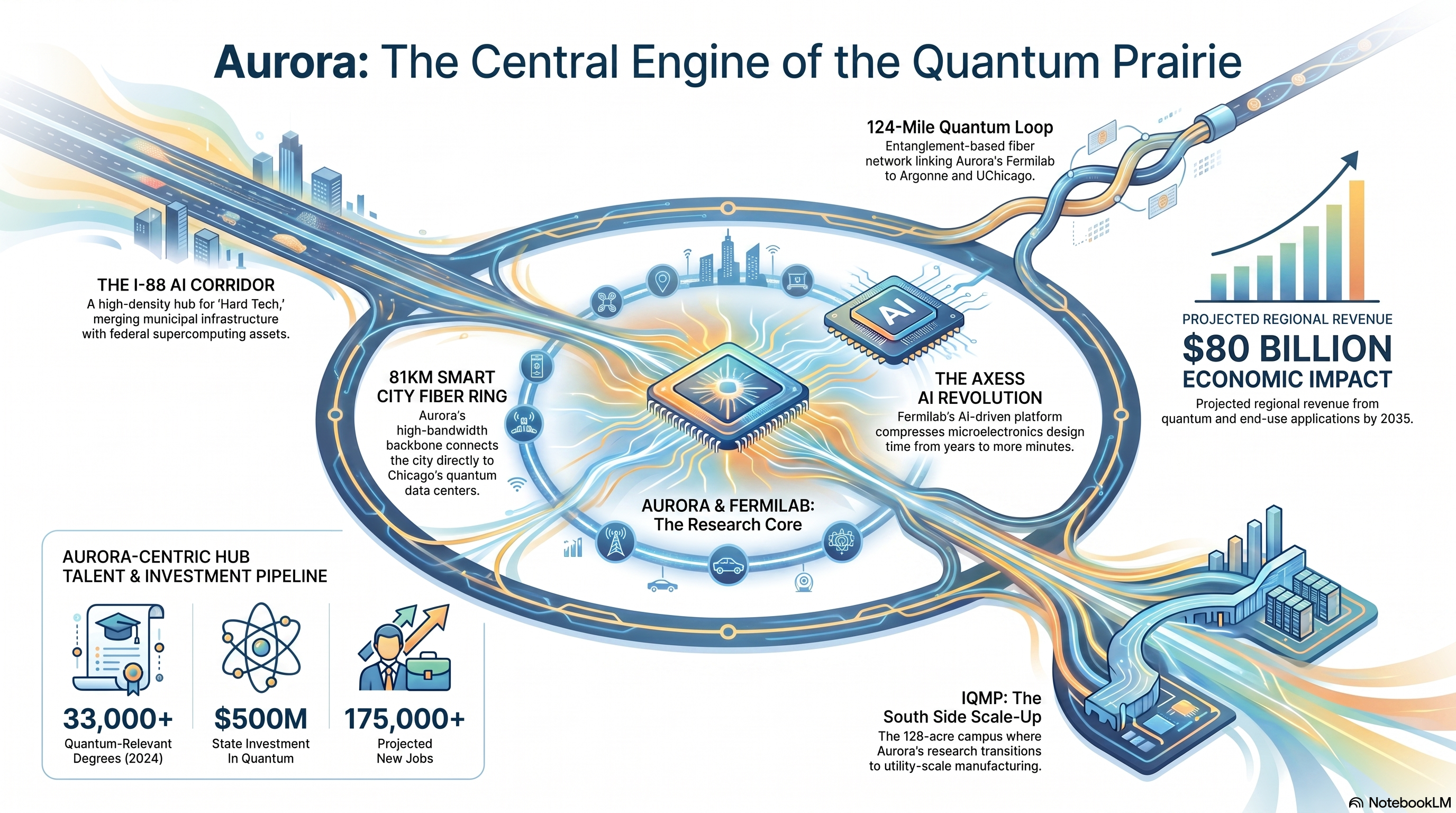
So What’s the Problem?
Same one we’ve had with AI: nobody’s paying attention. While other communities build coalitions and plug into workforce pipelines, Aurora watches from the sidelines until the wave’s already passed.
We wasted close to two years writing about how to talk about AI governance in Aurora while Boston and Philadelphia ship real solutions to real residents. The Quantum Prairie moves faster than that. The Chicago Quantum Exchange already connects 210+ researchers across seven universities. DARPA set up a proving ground at the IQMP. Fortune 500 companies are teaming with startups.
The table’s being set, the seats are filling, and Aurora hasn’t even acknowledged the invitation.
We’re Not Writing This From the Bleachers
Full disclosure: Jim is Director of AI Research at Global Data Sciences, Mike is the CEO, and we haven’t gone anywhere. We ran the AI Summits and Seminar. We wrote the municipal AI governance frameworks. We put AI community engagement models on the table when the city was paying for consultant contracts instead. Some of it landed. Most of it sat in inboxes.
We’re not recounting this to complain. We’re recounting it because it means we know exactly what it costs to do this work without the city standing behind you, and we also know the work still needs to get done. GDS is very much in the fight, and we are shipping custom construction-related AI tools that tradespeople can use at work right now. The question was never whether somebody in Aurora would show up for this stuff. Somebody has. The question is whether Aurora shows up with us.
What Showing Up and Doing Actually Looks Like
None of this requires a $200,000 consulting contract. It requires deciding to care, then doing four unglamorous things:
Have a public conversation with Aurora University about the Chicago Quantum Exchange. The CQE just added Purdue to a roster of seven universities. They’re expanding. A phone call costs nothing. The City has made calls like it before; it works better when today’s Mayor makes them too.
Widen the workforce conversation past AI. Quantum readiness at the technician level — fabrication, assembly, the jobs that don’t need a doctorate — belongs in Aurora’s planning now. Not in the refresh cycle of a roadmap nobody’s read.
Put quantum on an alderman’s agenda. Any alderman. One. Economic development tied to this corridor is a regional game, and DuPage, Cook, and Springfield are already playing it. Aurora doesn’t get dealt in by waiting. Which Alderman is up to the task?
Hold a Quantum 101 night. Plain language, open doors, no slide decks. The AI Summits we held here proved residents will show up when you actually invite them. That muscle still works. Let’s use it.
The Bigger Picture
The UN named 2025 the International Year of Quantum — a hundred years since quantum mechanics was born. We’re at the hinge point between understanding the theory and actually using it.
Chicago is rebuilding its industrial identity around qubits instead of rivets. Aurora doesn’t get to opt out of that transformation — it WILL reach us either way. The only question is whether the city joins the people already doing the work, or spends another election cycle explaining why it didn’t.
A cake decorator is building the future of computing. Aurora City Hall hasn’t picked up the phone.
If you’re tired of watching this from the sidelines too - resident, teacher, alderman, whoever - the comments are open. We’ve kept the light on this long. Help us keep it on.
Disclaimer: This article was collaboratively written by Jim Schweizer, Mike Mantzke, and Claude Fable and Google NoteBookLM. Global Data Sciences has created an innovative structured record methodology to enhance the AI’s output and used it in the creation of this article. AI contributed by drafting, organizing ideas, and creating images, while the human author prompt engineered the content and ensured its accuracy and relevance.
 | A guest post by
|
"Frustrated that Illinois lost tech professionals and their ventures to Silicon Valley during the Internet boom, Governor Pritzker told the Wall Street Journal that he did not want Illinois to miss out on an opportunity like that again in the experimental field of quantum computing. Beginning in 2018, the Pritzkers worked with the Commercial Club of Chicago, one of the city’s oldest and most elite business groups, which reported more than $18 million in assets last year, on a comprehensive plan to turn Chicago into a leading tech city capable of competing with places like Silicon Valley. They called it a “Burnham Plan for Tech,” referencing the famed 1909 plan by architects Daniel Burnham and Edward H. Bennett to beautify and transform Chicago."
https://chicagoreader.com/news/quantum-crossroads/quantum-pritzker-illinois-iqmp/
The companies involved in the Quantum Prairie are moving forward at light speed. "This agreement will also enable #PsiQuantum to invest in essential infrastructure at the company’s facilities in Milpitas, California, and #Chicago, Illinois, as it advances toward building and deploying the world’s first utility-scale, fault-tolerant quantum computers."
https://thequantuminsider.com/2026/07/22/psiquantum-signs-125-million-agreement-with-darpa/